Reader Question 11: Lumper Status... Is it Terminal?
Hi Anna,
I recently came across your blog post dichotomizing Lumpers and Splitters. I am very obviously a Lumper; my world is contained in a single diary of 800 unlined handwritten pages. This system is deeply unwieldy for real knowledge management. Any advice for how a Lumper might become a Splitter? Every new notebook I try to buy with A Specific Purpose is gathering dust in a corner in favor of the giganotebook. Please help!
Thanks, Machine
Dear Machine,
A few months ago, I tried a new thing. I got my hair chemically straightened. During our hot, humid summers where I live, my natural hairstyle makes me look like a cartoon lady who just realized she dropped her phone and wallet at a sketchy gas station about fifty miles back.
It was fun to try the hair straightening thingie, but my hair has its own way of being and soon was springing free of its chemical bonds. Frizzy is what my hair naturally is; and I would have to change my routines and $pend a lot of time and money on processes and products to make it otherwise.
What does this have to do with being a lumper or a splitter?
I think the question is, if being a lumper or a splitter is also a natural tendency, how much work would one be willing to put in, to do things differently than what comes naturally?
Just as I have always envied the tidiness of the look of straight hair, I – a natural splitter – have always envied those who can keep everything in one notebook.
I also would love to see your giant notebook! (Is it very thin paper??)
Anyway. Just like straightening my hair required me to invest more time and money and change up my usual routines, moving from being a lumper to a splitter requires certain changes, certain infrastructure in place, if you will.
For any system or process that we want to adopt, we must create an external environment that supports it.
For a lumper who successfully writes handwritten notes into one notebook, I’m assuming you’ve already set up this much infrastructure for yourself:
- a big honkin’ notebook to write in, like yours
- a notion of what you prefer to handwrite in your notebook, versus what you plan to enter into a digital device
- easy access to pens and/or pencils you enjoy using, which are ready to write with (fountain pens filled with ink, if you like using those; gel or ballpoint pens that have not dried out; pencils with lead and erasers ready to use)
- a place or places where you reliably keep your notebook and writing instruments (because if you can’t find your notebook or a pen, you can’t write in it)
Splitters have to maintain all of the above, plus additional infrastructure, such as:
A clear and well-defined purpose for each notebook.
Both lumpers and splitters have to decide what to use paper for, and what to use digital for.
But a splitter also has to decide which paper notebooks to use for which functions.
In a way, separate notebooks are like separate apps. One might divide the recording of one’s personal information between a calendar app, a habit-tracking app, a notes app, an outliner app, a task app, and so on.
For me, each bullet point below is information I keep in its own, separate notebook:
- checklists and routines
- cooking notes
- cleaning and housekeeping notes
- daily planning notebook (I use a Wonderland 222 notebook for this, it has a timeline along the left margin)
- weekly/monthly/yearly planning notebook (I like the Wonderland 222 planners, U.S. holidays only btw) - and splitter that I am, of course I have one of these for work and another one of these for personal planning
- notes from work meetings
- notes from personal meetings and appointments
- my thinking book, where I jot down notes about various plans and projects
- journals – morning pages and a few others
- a capture notebook
- a writing notebook, for writing I might share publicly
- various pocket notebooks that operate as “satellite” notebooks – I make notes on the go, and then move those notes into my computer or other notebooks
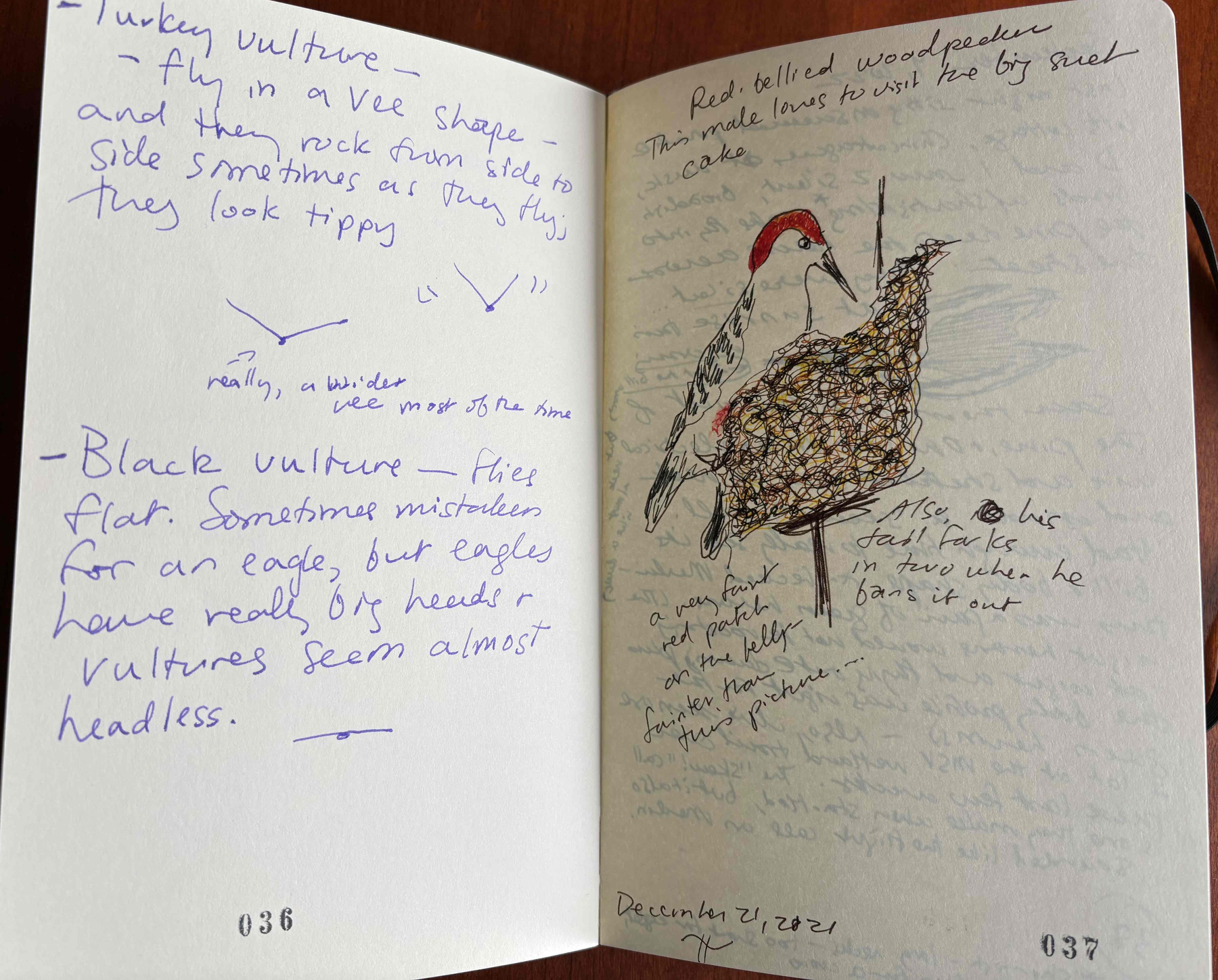
- my Boid Book, which is just a notebook with blank pages, where I make birdwatching notes, draw pictures of birds, and disambiguate fish crows from American crows, etc (btw I love fish crows, they are hilarious)
Here is something from the Boid Book:
A specific place for each notebook.
For each of those notebooks I listed above, I have a specific place to store them, usually as convenient as possible to where I’ll use them.
If I’m looking at a green composition book in the kitchen cabinet above the phone chargers, that is where I will find my cleaning notes. And also the note about the best DIY fruit fly trap. *
The cooking notes notebook is in the same place, but rather than being a composition book, it is a cute notebook with cat drawings in it, that I couldn’t resist buying.
If I’m looking at my planners, they are on their very own shelf in my home office.
Journals: one by the art supplies, one in a Secret Location.
And so on.
Notebooks you can tell apart at a glance, so you don’t have to open them to read the contents.
I like to use dedicated notebook covers to tell my various notebooks apart. You could also write a title on your notebooks, if you prefer not to use a cover.
If I’m looking at my cherry-red notebook cover, my current capture notebook is living in there. If I’m looking at my olive green notebook cover, my current weekly planner lives in there.
And so on.
Knowing what each notebook is for, knowing where I keep it (and making that place convenient to its uses), and knowing exactly what it looks like without having to open it to figure that out, is the infrastructure that allows me to find and use multiple notebooks with little trouble.
I hope this helps!
* DIY fruit fly trap: Take a clean jar (I use one about the size of a pickle jar), and pour in about a half-cup of apple cider vinegar. Add 1 or 2 drops of dishwashing soap, and mix vigorously. Cover the top with plastic wrap and poke holes in it. The key is the apple cider vinegar: they LOVE it.
Copy and share – the link is here. Never miss a post from the Analog Office! Subscribe here to get blog posts via email.
Wondering how to manage your paper-based or hybrid paper-digital systems? Ask me a question.